
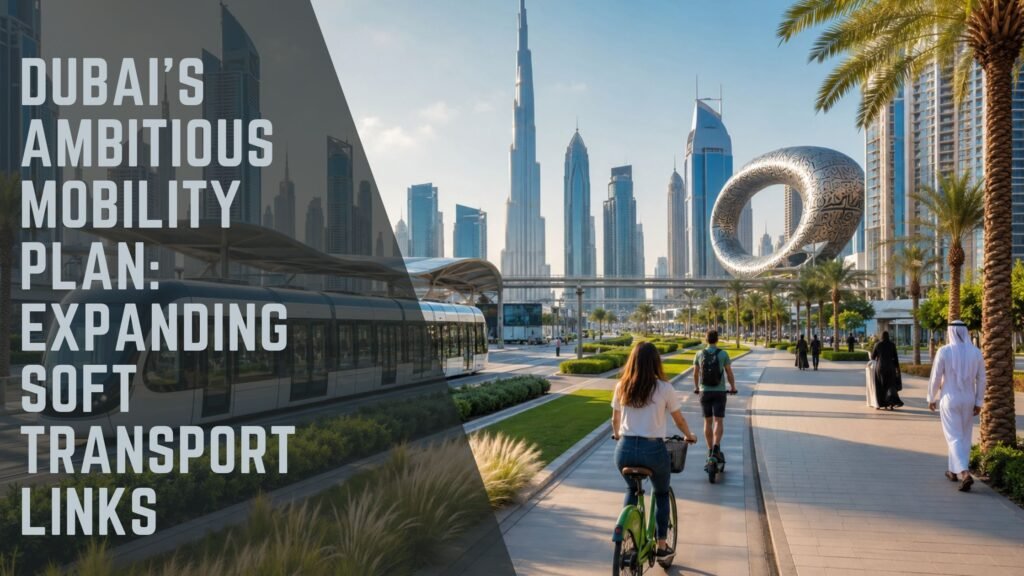
Dubai’s Roads and Transport Authority (RTA) has unveiled an ambitious five-year initiative to expand its soft mobility network, which includes walking, cycling, and e-scooter paths. This strategy is designed to enhance public transport accessibility while decreasing reliance on private vehicles.
Enhancing Connectivity Through Soft Mobility
The initiative focuses on improving ‘first- and last-mile’ connections, an essential element in public transport planning. By enhancing pedestrian, cycling, and micro-mobility infrastructure, the RTA aims to facilitate easier transitions between residential areas and public transport services.
Widespread Infrastructure Upgrades
By 2030, infrastructure upgrades are planned across 25 residential communities and 63 public transport stations. These upgrades will create stronger links between neighborhoods and the wider public transport network. The selection of upgrade locations is based on criteria such as population density, current public transport usage, land-use patterns, and the strategic priorities identified in the Dubai 2040 Urban Master Plan.
Leadership Insights and Strategic Goals
Mattar Al Tayer, Director-General and Chairman of the RTA, emphasized that the initiative is aligned with Dubai’s goal to develop a sustainable, modern, and people-centric transport system. Soft mobility is increasingly crucial in integrating various modes of transport and promoting the use of public transport, thereby supporting the city’s sustainability goals.
Measuring Success in Modern Transport Systems
Al Tayer highlighted that the effectiveness of modern transport systems is now measured by their ability to provide seamless transitions between different travel modes, rather than the efficiency of individual services alone. This perspective is driving the RTA’s efforts to expand and enhance Dubai’s soft mobility options.
Growing Adoption of Alternative Mobility
Dubai has already seen a rise in the use of alternative mobility options. Pedestrian journeys increased from 326 million in 2024 to 342 million in 2025, while cycling trips surged by 23%, reaching 57.3 million in the same period. Electric scooter usage also reflected similar growth, jumping from 32.3 million to 39.6 million.
Infrastructure and Satisfaction Metrics
The city’s pedestrian satisfaction levels have reached 89%, with infrastructure readiness around public transport stations at 87%. These metrics underscore the growing acceptance and integration of soft mobility options in Dubai’s transport landscape.
Future Developments and Community Impact
The next phase of the strategy will focus on enhancing connections between residential areas, business districts, and key destinations. This involves improving access to Metro stations, bus services, and other public transport options. The initiative will include the development of bicycle lanes, expanded pedestrian routes, shaded walkways, rest areas, safer crossings, and facilities for People of Determination, among others.
Comprehensive Coverage by 2030
By 2030, soft mobility infrastructure is expected to cover 34 residential areas. Current projects are underway in Dubai Marina, Al Murar, Naif, Al Rigga, and Al Muraqqabat, with upgrades completed in areas like Al Mankhool, Al Qusais, and Al Karama.
Integrated Transport Vision
The RTA has also enhanced areas around 37 Metro stations, including Mall of the Emirates and Burj Khalifa/Dubai Mall, with improved walking and cycling infrastructure and shared mobility facilities. These developments are part of Dubai’s broader vision to create an integrated transport ecosystem that seamlessly connects Metro, Tram, buses, marine transport, taxis, and individual mobility options.