
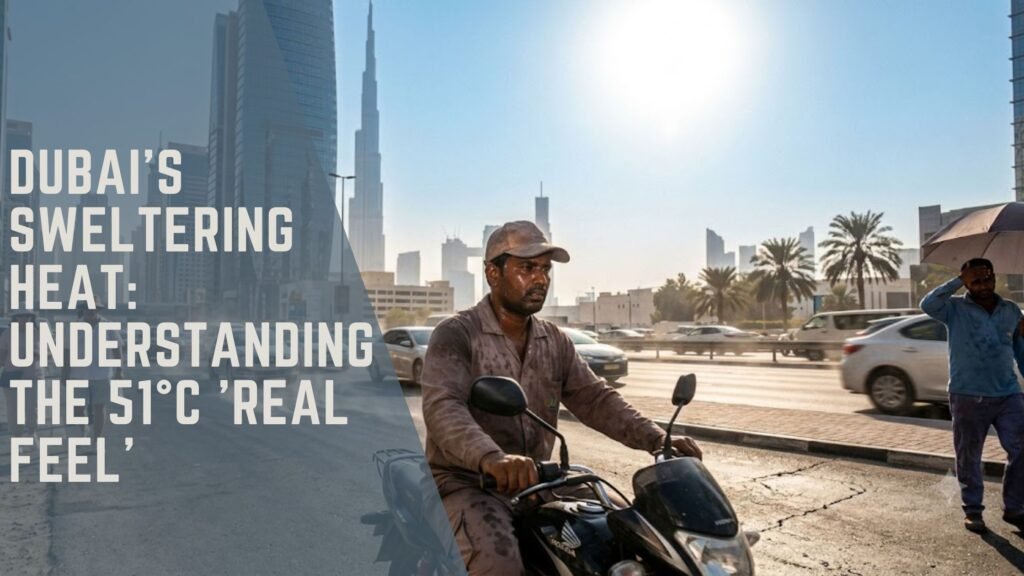
The United Arab Emirates is experiencing an intense heatwave, with Dubai temperatures reaching 44°C. Despite this, residents feel the heat at a staggering 51°C, leaving many wondering why.
Humidity: The Hidden Culprit
The National Centre of Meteorology (NCM) attributes this increased ‘real feel’ to a significant rise in relative humidity, which has surged to between 65% and 85% in inland areas and up to 90% in coastal and mountainous regions. This spike in humidity elevates the perceived temperature by an additional seven to nine degrees.
Understanding the Comfort Index
Dr. Mohamed Al Ebri, head of meteorology at NCM, explains that high temperatures combined with elevated humidity levels drastically increase the apparent temperature, leading to uncomfortable conditions particularly during the afternoon and early evening.
Science Behind the Heat Index
The Heat Index, also known as the Comfort Index, reflects what the temperature feels like to the human body. According to the National Oceanic and Atmospheric Administration (NOAA), the body’s ability to cool itself through perspiration is hindered when humidity levels are high, causing a rise in the perceived temperature.
Factors Influencing Thermal Comfort
Dr. Al Ebri emphasizes that thermal comfort is not solely determined by air temperature but also by humidity, wind speed, and direct exposure to sunlight. These factors together can lead to a perception of elevated temperatures even when the mercury dips slightly.
Seasonal Expectations and Weather Patterns
As the UAE progresses through August, temperatures typically remain high, though brief decreases may occur due to northwesterly winds. However, these are often countered by increased humidity, especially along the coast.
Humidity and Mist Formation
The NCM forecasts a further rise in humidity during the night and into Thursday morning in coastal regions, increasing the likelihood of mist formation.
Rainfall: A Welcome Anomaly
Despite the heat, there is a forecast for fair to partly cloudy weather, with potential convective cloud development and rainfall in the eastern and southern parts of the UAE. This is a rare occurrence during the typically dry summer months.
Temperature Trends Across the Emirates
While humidity climbs, actual temperatures remain steady in the mid-40s. Coastal and island regions are expected to experience highs between 39°C and 45°C, whereas internal areas could see temperatures from 45°C to 50°C.
In major cities, Abu Dhabi, Sharjah, and Ras Al Khaimah are projected to peak at 45°C, with Dubai slightly cooler at 44°C. Fujairah will be the mildest at 36°C, while Al Ain and Liwa will face the most extreme heat, at 46°C and 49°C respectively.
Sea Conditions and Wind Patterns
The forecast includes light to moderate winds, occasionally fresh, reaching up to 35 km/h along the coast. Sea conditions are expected to be slight in both the Arabian Gulf and the Sea of Oman, with gentle waves reaching up to three feet offshore.
Here is a detailed breakdown of minimum and maximum temperatures across the Emirates today:
Maximum Temp (°C) Minimum Temp (°C)
Dubai 44°C 31°C
Abu Dhabi 45°C 32°C
Al Ain 46°C 35°C
Sharjah 45°C 32°C
Ajman 43°C 31°C
Fujairah 36°C 32°C
Ras Al Khaimah 45°C 30°C
Umm Al Quwain 42°C 32°C
Liwa 49°C 32°C